
Calendar
Tablescapes
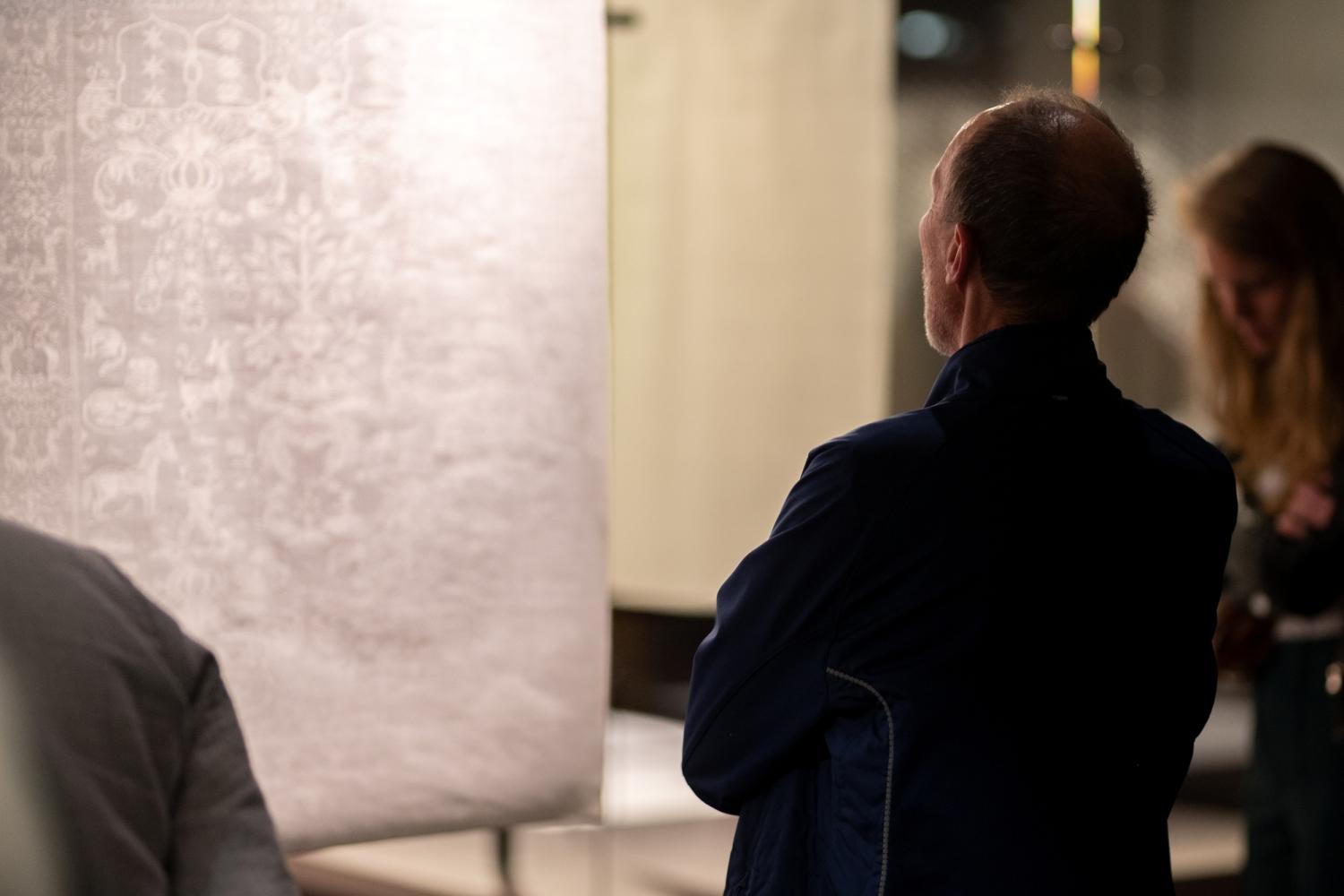
Damask is craftsmanship at its finest. In the right light, stories emerge, woven in white on white: stories of love, pride, hospitality and faith. With Collection Presentation #6, Texture presents a selection of napkins and tablecloths from its historic damask collection, alongside contemporary work by master artist Joan Sallas and textile designer Emilie Palle Holm.

A beautifully laid table is always a spectacle. Today, but also in 16th, 17th and 18th century Europe. Back then, luxurious damask napkins and pleated linen sculptures took centre stage: a feast for the eyes. Woven napkins and tablecloths – simple utensils – rapidly developed into sought-after luxury items and a true art form. In the Low Countries, the sharp folds of a crisp tablecloth were a sign of prosperity. In the 16th century, a new fashion emerged in the courts of northern Italy: folding linen into elegant sculptures. Instruction books such as Li tre trattati by Mattia Giegher (1629) quickly spread these techniques throughout Europe.
Today, Joan Sallas is breathing new life into these 'table triumphs'. Based on historical sources and images, he reconstructs folding techniques and the meaning of the textile table sculptures. Emilie Palle Holm's 3D woven centrepieces tie in with this: they are related to the centuries-old napkin folds, but at the same time innovate the technique. Together, they bring a special table art back to life in Tablescapes.
Emilie Palle Holm has a master's degree in textiles from the Swedish School of Textiles (University of Borås). Her Oriori work gives new meaning to the centuries-old art of folding in the context of contemporary textile design. By applying contemporary 3D weaving technologies to a jacquard loom, it is possible to change the shape of the woven sculptures and structures. In doing so, she explores how flat textiles can be transformed into dynamic spatial forms.

The technique of damask weaving originated in Asia. It found its way to Europe via the silk routes, trade connections and the Crusades. In the Low Countries, Kortrijk became known for its skilled, internationally renowned linen weavers. At the end of the 16th century, many Southern Dutch fled to the north due to religious unrest and economic uncertainty. Many Kortrijk weavers settled in Haarlem, a city with a thriving textile and bleaching industry where they could continue their craft. The city grew into a centre for damask production and linen trade, in which well-known Kortrijk residents such as Passchier Lammertijn played an important role.
The damask woven in the Low Countries found its way to European royal courts and the homes of wealthy citizens. It was made to mark a wedding, a victory in battle, as a gift or as a conversation piece at the table. We invite you to take a slow look at Tablescapes and see flowers, writhing snakes, roaring cannons or a dove with a twig appear. A play of light and shadow that only becomes visible when you really look. Look, search and discover.
Catalan Joan Sallas is a true folding expert and artist. Historical research into the art of folding forms the basis of his practice, together with teaching the techniques. Based on historical sources, such as Li te trattati by Mattia Giegher (1629), he reconstructs the techniques, meanings and functions of folded table decorations. Joan Sallas has folded for Queen Elizabeth II of England and Crown Princess Victoria of Sweden, and his work has been exhibited in various museums.
Tablescapes. Between Fold and Prestige can be visited until 31 August 2027. You can also book a guided tour of the exhibition for extra insight and depth. Discover our public programme via the calendar: De Vouwkeuken (permanent - workstation in the exhibition room), Plantoid (16.10 - 04.01 - installation), damask weaving (10.01 & 11.01 - masterclass).

Experience Tablescapes. Between fold and prestige