

News
A knitting machine as a 3D printer

A knitting machine as a 3D printer
From craft to passion and back again
This autumn, Gaspard Fleury-Dugy is taking up residence at Texture. The Paris-based designer and artist works at the intersection of craft and innovation, something we absolutely love at Texture. So it comes as no surprise that in 2025 he became the very first winner of the Texture Prize at the Objet Textile Biennial at La Manufacture in Roubaix. We sat down with him for a conversation.
At Texture, we don’t just look back at the craftsmanship and entrepreneurship that shaped our former textile region. We also show how they continue to inspire innovation and creativity today. Textile artist Gaspard Fleury-Dugy fits perfectly into that story:
“I love taking traditional techniques and twisting them into something new. When people see my work, they often think it’s made using 3D printing or ceramics. When I explain that it’s actually just knitting, like their socks, for example, they’re surprised. It opens up a whole conversation about technique and production. I like making people look at things differently.”
Gaspard Fleury-Dugy arrived at this surprising and unconventional way of working through a journey shaped by both conscious choices and chance discoveries. It began back in secondary school, where he chose Sciences et Technologies du Design et des Arts Appliqués. A course that suited him perfectly or almost: “There was one thing I really struggled with: traditional drawing. So I gradually focused more and more on textiles. Colour relationships, patterns, lines: they offered me a much freer and more sensitive way of drawing.”

The École Duperré for Applied Arts in Paris was therefore a logical next step. There, almost by chance, he discovered the knitting technique that he now loves using in his art: “We were introduced to pretty much every textile technique. Knitting appealed to me most, especially when I discovered that you can create volume with it. You can manipulate a knitting machine in such a way that it almost becomes a 3D printer.”
He became fascinated by industrial knitting machines: “Step by step, I learned how to work with them and explored how I could push their possibilities further to create something innovative. That’s how my own visual language developed. I often say now that the machine is my pencil, and the yarn is the lines I draw. Not flat lines, but sculptures or better still, architecture.”
The link with architecture is never far away. Gaspard is a fan of architects who work with curved lines, such as Brazil’s Oscar Niemeyer and Spain’s Santiago Calatrava, who combines engineering and architecture to create spectacular, almost “impossible” bridges. Those shapes and volumes are clearly reflected in his Soft Objects series, which in their own way are almost equally impossible. He also draws inspiration from the colours and movements of the circus. As a trapeze artist, he sees his work as a series of fluid and colourful pirouettes: a play of movement, balance and rhythm.
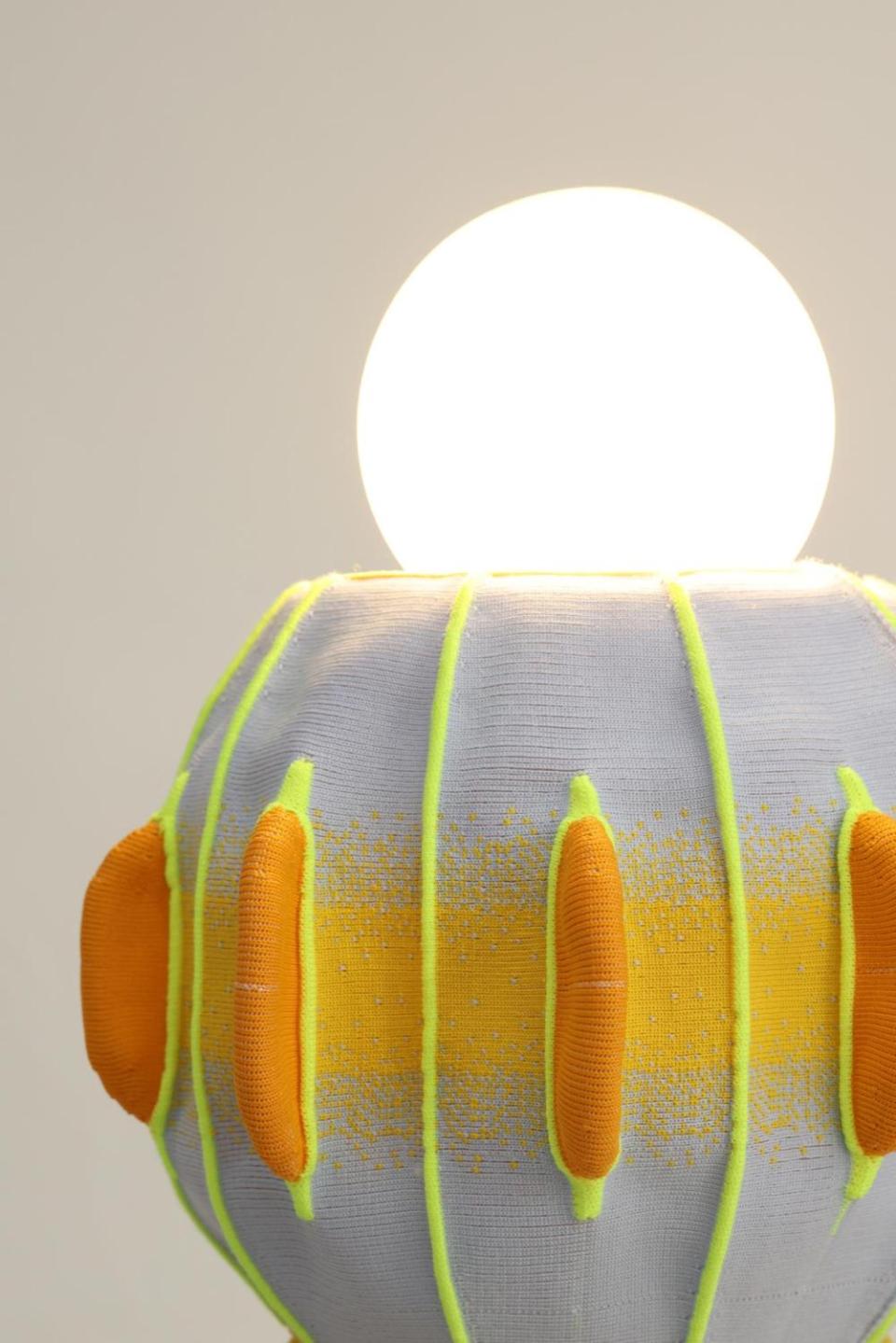
To make the impossible possible, he makes clever use of new technologies: “I usually start by drawing shapes in virtual reality. I put on a VR headset and use digital tools to experiment with all kinds of volumes. Once I’ve found a shape I like, I virtually cut it into pieces. I then code those pieces and use them like a kind of construction kit to program the industrial knitting machine. After that comes the work on colours and patterns. Those patterns are often inspired by traditional techniques, such as woven baskets.”
The result of this remarkable combination of tradition and innovation throws you off balance as a viewer. His first collection, Soft Objects, evokes memories of classical vases, while at the same time recalling our contemporary digital visual culture. Natural forms are combined with futuristic details. The colours are both vivid and soft. For a moment, your senses don’t quite know where to begin…
Meanwhile, Gaspard Fleury-Dugy has established his own design studio and continues to experiment. He is working towards making his pieces even more immersive, for example by playing with light elements. His work has already been presented in Paris, Milan, Eindhoven and at the World Expo in Osaka. And now he is our guest at Texture, a Belgian first. In the exhibition Soft Objects, he presents existing work while also developing new objects especially for Kortrijk. A must-see.